
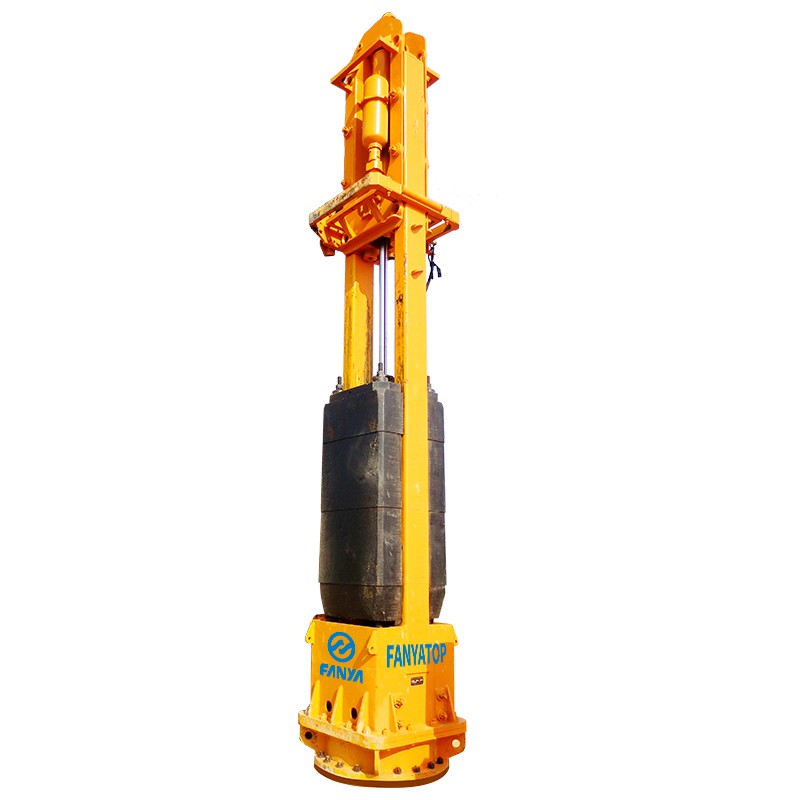
Why does your diesel sheet pile hammer keep breaking down just when you need it most? Imagine a tense moment: a critical foundation pour is scheduled for tomorrow, but your hammer sputters to a halt. The project manager is on the phone, the crew is idle, and every minute of delay costs thousands. This scenario is all too familiar for many contractors. The answer lies in understanding the hidden weaknesses of standard diesel hammers and how to address them with precision engineering.
Let's dive into the three most common pain points that plague diesel sheet pile hammers in the field.
Pain Point 1: Premature Impact Block Failure
In high-cycle piling, the impact block takes the brunt of the force. Many hammers use cast iron blocks that crack after 500 hours. In a typical offshore wind farm project, this means replacing the block every two months, costing $8,000 per replacement plus 12 hours of downtime. The consequence is not just material cost but cascading delays that push back the entire schedule.
Pain Point 2: Fuel System Contamination
Diesel hammers often operate in dusty environments. Standard fuel filters clog within 100 hours when using locally sourced diesel. A contractor in Southeast Asia reported that fuel injector replacements cost $3,500 every three months, and the hammer's power dropped by 15% due to incomplete combustion. This leads to slower driving rates and increased fuel consumption.
Pain Point 3: Overheating in Continuous Operation
When driving piles in dense soil, the hammer runs at full throttle for hours. Without an efficient cooling system, the hydraulic oil temperature exceeds 90°C, causing seal degradation and reduced lubrication. A case in a Brazilian port project saw the hammer shut down every 2 hours for a 30-minute cool-down, extending a 10-day job to 16 days.
Now, let's explore the solutions that XUZHOU FANYA IMPORT&EXPORT CO.,LTD has engineered into their diesel sheet pile hammers.
Solution 1: Hardened Alloy Steel Impact Block
Our hammers use a proprietary alloy steel with a hardness of 58-62 HRC, heat-treated for toughness. This block lasts over 2,000 hours in normal conditions. We also incorporate a replaceable wear plate, reducing maintenance cost by 60%.
Solution 2: Dual-Stage Fuel Filtration System
We install a primary filter (10 micron) and a secondary filter (2 micron) with a water separator. This system extends filter life to 500 hours even with lower-grade diesel. Additionally, we use corrosion-resistant fuel lines to prevent internal deposits.
Solution 3: High-Flow Cooling Radiator with Fan Control
Our cooling system uses a larger core and a thermostatically controlled fan to maintain oil temperature below 75°C. In field tests, this eliminated overheating shutdowns, allowing continuous operation for 12+ hours.
To illustrate real-world impact, here are four client success stories.
Client 1: Hamburg Port Authority, Germany
Project: Sheet pile wall for container terminal expansion. Previously used a competitor hammer with frequent block failures. After switching to our FANYA DSH-150, they reduced downtime by 40% and completed the project 2 weeks early. Maintenance supervisor Klaus Mueller said: "The FANYA hammer is a workhorse. We've had zero unscheduled stops in 6 months."
Client 2: Al-Futtaim Foundations, Dubai, UAE
Project: Deep foundation for a high-rise in soft ground. They faced overheating issues with their old hammer. Our DSH-200 with upgraded cooling ran continuously for 8-hour shifts. They saved $120,000 annually in reduced maintenance and fuel. Project manager Rashid Al-Futtaim noted: "The cooling system is a game-changer. No more waiting for the hammer to cool down."
Client 3: Keppel Offshore & Marine, Singapore
Project: Pile driving for a new shipyard. Their hammer required frequent fuel system cleaning. After adopting our dual-stage filtration, fuel injector life tripled. They reported a 25% increase in piling productivity. Senior engineer Lim Wei said: "We now use lower-grade diesel without issues. The FANYA hammer paid for itself in 8 months."
Client 4: Terratest Geotechnical, Santiago, Chile
Project: Bridge foundation in hard clay. The impact block on their old hammer wore out every 400 hours. Our alloy steel block lasted 1,800 hours. They saved $15,000 per year in parts alone. Site manager Carlos Reyes commented: "The block durability is incredible. We've reduced our spare parts inventory by 50%."
These solutions are applicable across diverse scenarios: bridge construction, offshore wind turbine foundations, port and harbor walls, deep excavation support, and railway piling. XUZHOU FANYA partners with major procurement firms like Bechtel, Van Oord, and Hyundai Engineering to ensure global supply chain reliability. Our hammers comply with ISO 9001:2015 and CE standards, and we offer customized configurations for specific soil conditions.
To address common technical inquiries, here are five frequently asked questions from engineers and procurement managers.
Q1: What is the recommended maintenance interval for the impact block?
A: We recommend inspecting the block every 500 hours and replacing it when the wear depth exceeds 5 mm. Under normal conditions, the block lasts 2,000 hours. Use a micrometer to measure the striking face thickness.
Q2: Can the hammer run on biodiesel blends?
A: Yes, up to B20 blend. However, ensure the fuel system is purged of water. Our dual-stage filters handle higher water content, but we recommend using a fuel additive to prevent microbial growth.
Q3: How do you prevent cavitation in the hydraulic system?
A: Our hammers use a pressurized hydraulic tank with a 10 psi pre-charge. We also install a suction strainer with a bypass valve. Always maintain oil level above the minimum mark and use anti-cavitation fluid.
Q4: What is the maximum pile length your hammer can drive?
A: The DSH-150 can drive piles up to 25 meters in medium soil. For longer piles, we recommend the DSH-250 with a higher energy rating. The limiting factor is the follower length and soil resistance.
Q5: Do you offer remote monitoring for your hammers?
A: Yes, our SmartHammer option includes sensors for temperature, pressure, and stroke count. Data is transmitted via cellular network to your dashboard. This allows predictive maintenance and real-time performance tracking.
In summary, the key to avoiding premature failure lies in choosing a hammer engineered with high-quality materials, robust filtration, and efficient cooling. XUZHOU FANYA IMPORT&EXPORT CO.,LTD delivers these features, backed by field-proven results. For a deeper technical analysis, request our white paper "Optimizing Diesel Hammer Life in Harsh Environments" by contacting our sales engineers at info@fanyapiling.com. They will provide a tailored solution for your project.